Ayecha? Eicha? – איכה

Eicha? How can it be?

“Eicha?” cries the mourner (probably Jeremiah) in the first verse of chapters 1, 2 and 4 in Lamentations.

It’s not some cursory “how?” He is literally asking: How can it be? How is it possible that such horrors have become our lot? How is it that the very backbone of our culture, our religion, our life – the Temple – is gone? How come we are left to eat our own flesh and blood? How come You are not answering our prayers? What happened to Your promises? What have we done to ourselves? And how come God Himself is silent and hidden – “Even when I cry out and plead for help, He shuts out my prayer” (Lam. 3:8, 43-44).

Ayecha? Where Are You?

Thousands of years earlier, God’s voice reverberated all throughout the garden as He walked there in the cool of the day (Gen. 3:8).

At that moment, what was the highlight of their daily routine, the time in which Adam and Eve heard God’s voice, turned into terror. They hid in fear, aware of their nakedness and ashamed of it.

This time, it was humanity that was hiding from God.

In Between Both Cries

The original Hebrew writing was comprised of consonants only, without spacing, vowels or markings. You had to hear each word in order to know how to pronounce it.

So long as Hebrew was a spoken language, the proper pronunciation of God’s Word was preserved. After all, the texts were read over and over at the synagogues. But things changed in the Middle Ages, and the concern was that the proper pronunciation will be forgotten. Several sages got together in Tiberias and developed a system of punctuation and vowelization (parallel to the Lain a, e, I, o, u). These were embedded in, below or above the letters themselves. Later on, this system was adopted by almost all Jewish communities in the diaspora.

The vowelizations of “Ayecha?” and “Eicha?” are different, but the Hebrew consonants are one and the same. Prior to the Tiberian system, unless you heard them read allowed, you could think this was the same word.

So even though we are reading it differently, even though each question is looking for a different answer, there are similar results in both events, to both cries, which are expressed with exactly the same consonants. And in between these two questions – Ayecha and Eicha – you find the jarring picture of mankind in its lowest moments.

When God asked Adama and Eve “where are you?” He already knew that the book of Lamentations will be written; that an entire nation will sit in sackcloth and ashes, and through dried lips will cry out these same letters, only with a different pronunciation. He also knew that hundreds of years later, around 70 AD, we will cry the same cry again, wondering once more: How come?

Behind a Tree

In Genesis, Adam and Eve hid behind a tree. By the time the book of Lamentations was recorded, there were hardly any trees left in Jerusalem. The Babylonians had cut them all out to make rams and beams for their siege over the city.

Fast forward a few centuries… the Romans did the same to the trees that grew up in the meantime on the Judean hills. When the remnant was marching through these hills into exile, they saw forests of crosses everywhere, with thousands of their relatives hanging on them. And again the cry was heard: How come? Eicha?

Cry Over Her

I know I am going back and forth in time in this post, but this is how the picture of human suffering looks like: patches of time and history and questions that are cried out. So please bear with me, as a few decades prior to that horrific march of starving Jews through a forest of bloody crosses, Yeshua stood on a slope on the Mount of Olives, looked over at Jerusalem and began to lament. He knew that both these cries were about to be heard again.

In the few words expressing His wailing (Vs. 42-44), you can easily tuck the entire five chapters of Lamentations. You can also hear an echoing of both Eycha and Ayecha?

Yeshua knew that He will soon be lifted up on another tree, which will become a stumbling block to His people; that each time we will see it, we will immediately associate Him and the Cross with our enemy; that His true, tender, longing voice will be deeply hidden from Jewish eyes; and that we will cry once more: “His Face is hidden from our eyes” (4:16).

He Is Who He Is

The 9th day of Av this year falls on Saturday, August 6. For 24 hours the religious Jew will sit on the floor as a sign of mourning, read Lamentations and other texts like it, and cry out to God: “Where are you? How come? How could you have brought such destruction and desolation upon us? Again and again!”

We can pray that within these cries – “How?” and “Eicha?” – they will not be afraid to hear God’s “Where are you – Ayecha?” That they will dare to step out of the box, out of the traditional vowelization and dots and iotas, hear Him and look upon that One Tree, where all answers are provided.

“El Mistater” – The God Who Conceals Himself; Singing: Haim Israel and Yoav Itzhak

Hear my voice, that is heard among all voices

by the God that accepts all prayers.

God that conceals Himself in a hidden canopy,

the mysterious Intelligence of all purpose.

The King of Kings is crowned with the highest crown.

God will grant you a crown!

And if I erred, you will have mercy on me,

absolve me, do not ignore my pleas.

I will open my arms, I will be comforted,

and I will magnify your name and make it glorious.

Please, please, please, oh please,
in your mercy.

In Your Blood, LIVE!

“The ancient words fill me with strength,
In the ancient voices I find healing.
They help me live,
They help me grow,
And create a better world.

“And when I passed by you and saw you wallowing in your blood,
I said to you: ‘in your blood, live!
Live, live, in your blood you shal live!’
I said to you: ‘in your blood, live!’

“Suddenly above my head appears a rainbow,
Spread wide as a colorful fan
Proclaiming life, declaring hope
and peace, tranquility and grace.

“And I said to you: ‘in your blood, live!’ ”

Naomi Shemer, an Israeli songwriter, who passed in 2004, took the words of the prophet Ezekiel (16:6), and applied them to the nation of Israel. They fit so well in the delicate seam between Israel’s Fallen Soldiers and Terror Victims Memorial Day, commemorated just moments before the sky is filled with fireworks and celebrations of Israel’s 74th Independence Day commence, while the radio still plays these soft, mournful songs.

Indeed, God saw Israel in her orphaned, widowed state (Ez. 16:3-6), and out of the bloodshed this land is so full of, He commands her to live!

I would like to paraphrase verse 6 a bit and say to Israel: in His blood there is life. In His blood you can live. Live in His blood!

Over 24,000 men and women had shed their blood for this land, many of them not even aware they were fulfillfiling ancient prophecies. Today we remember them and lay flowers on their graves in various ceremonies held throughout the country. It is time, Israel, to acknowledge another grave, one that requires no flowers, as it has long been emptied by the Resurrected One, who shed His blood for all of us.

And to you, my beloved ancient Israel, I wish that this year, as you are still so young, that you will look to Him to turn your mourning into dancing, and your sorrow into joy. And as you lift your eyes up to the fireworks that will fill heavens in just a few short hours, a rainbow will spread above your head, and the Lord of hope will fill the emptiness in your heart with peace, tranquility and grace.

https://www.youtube.com/watch?v=0krT8xzNbyM&feature=youtu.be

Shemer’s song performed by Ruchama Raz.

Could Have

Photo credit: lanuevacronica.com

Polish born poet, Wislawa Szymborska, is considered one of the greatest poets of the 20th century. The Polish authorities tried to silence her and outlawed her poems, as they did not align with the communist ideology. But she continued developing her unique voice, and eventually won the Nobel prize in literature (1966).

In one of her poems Szymborska stated that “no more than two out of a thousand care for the art (of poetry)”. In reality though, copies of her books have been sold in quantities that compete with prose, and were translated into a myriad of languages, among them Hebrew.

In a simple, direct style, bare of the artistic flowery elements that usually characterize poetry (rhymes, imagery, motifs, etc.), she touches on some of the most monumental issues, using the simplest of means. In almost all of her poems she captures small moments and lingers on them, while expressing much acceptance of human weaknesses.

Her poem “Could Have” caught my eye. From a different angle she tells the story of survivors of a war that is not named specifically, but is well recognized between the lines.

Could Have

It could have happened.
It had to happen.
It happened earlier. Later.
Nearer. Farther off.
It happened, but not to you.

You were saved because you were the first.
You were saved because you were the last.
Alone. With others.
On the right. The left.
Because it was raining. Because of the shade.
Because the day was sunny.

You were in luck – there was a forest.
You were in luck – there were no trees.
You were in luck – a rake, a hook, a beam, a brake,
A jamb, a turn, a quarter-inch, an instant…
So you’re here?

Still dizzy from another dodge,
close shave, reprieve?
One hole in the net and you slipped through?
I couldn’t be more shocked or speechless.
Listen, how your heart pounds inside me.

(https://www.poemist.com/wislawa-szymborska/could-have)

The national annual holocaust memorial day (Yom HaShoah) starts tomorrow. The thousands of survivors who are still among us, like Mania and Esther, Miriam and Inna, Arkady and Yafim and the others we keep in touch with throughout the year – for the most part believe it’s a mere coincidence that they survived. Will you take a moment, think about their bruised soul, and pray that they will lift up their eyes to the One who saw every “could have” they have been through, and has a mysterious way to weave their brokenness into the wholeness His Son’s blood provides?

Absalom Smith

The famous slap heard around the world is still stirring up waves – even weeks later. I presume you have all heard its echoes all the way to your parlor. But if for some reason you are unaware of what I’m referring to, you can read all about it in the link at the bottom of this post.*

What has stirred such a fire under the feet of the Prince of Bel Air, that up to that point was watching with wide grins, as Chris Rock was joking at the expense of others? Was it just his wife’s honor he was trying to defend when he jumped out of his chair?

I kind of doubt that. After all, now, not only does the whole world know that Jada is bald, (almost) everyone talks about it, adding snarky remarks about her hot-headed husband, who, God only knows, may be quick to raise his hand to her as well? Or simply put: Assuming Will wanted to protect her honor, he ended up just dumping it into a deeper hole.

Great Honor

But if this is what he was really concerned with, could he have acted differently? From the video that went viral, it looks like Will didn’t even glance at Jada before he jumped up to slap Chris Rock. Maybe he thinks that what hurts him also hurts her; that his muscular arm will suffice to fill his wife and the audience with awe. But had he stopped for a second, he would have realized that what he is about to do will only accomplish the opposite, and that he is about to expose his wife to further humiliation.

I wonder what went through Jada’s mind in those seconds. She may have started the day with a visit to her manicurist, followed by a trip to the hair salon, before she put on the fancy clothes and accessories she chose so carefully. After all, her husband was nominated for best actor, which meant the cameras will focus on them quite a bit. Great honor was awaiting them! So what went through her mind when right there, in front of the whole world to see, the hope was shattered and the narrative reversed?

Who Cares, Anyway?

The story in and of itself may be interesting, but that’s not the reason I bring it up here. I am looking into it because of its resemblance to a Biblical story, one that is pretty hard to digest.

This has been the worse day in the life of Princess Tamar. It could very well be that it too started with some beautification treatments, and carefully choosing a beautiful garment denoting her virginity, and jewelry to accentuate her beauty. After all, she was just invited to personally care for the heir to the throne. Great honor indeed! 

It could well be that Tamar had her eyes already set on Amnon (though the Torah forbade marriage between half-siblings, it doesn’t look like David’s kids really took heart to keep the commandments). Amnon was the firstborn, the successor to the king. And if she indeed had any dreams of marrying him, it means that his abusive actions had hurt not only her physical body, but broke her heart and shattered her dreams as well.

2 Samuel 13 tells how in mere minutes, Tamar’s world turned upside down. From a respected, honored princess, wearing a royal diadem, she became a broken mess with ashes covering her head. That morning started with a desire to assist her brother out of love and goodwill, but by day’s end, she was left with a shattered heart and a body that was forever broken.

Up to that point, Tamar wore a beautiful garment, designed for the virgin princesses (v. 18). Once Amnon stole her virginity, she outwardly did what she felt on the inside. She tore the robe, spread ashes on her head, and began screaming.

Hush Now

At this point, her own Will Smith – brother Absalom – enters the scenery and takes matters into his hands. “Hush now, hold your peace, keep quiet!” he commands Tamar, “he (Amnon) is your brother; do not take this thing to heart!” (v. 20).

Credit: Love Quiding. Charcoal portrait drawing series

Or simply put: “Forget your own feelings and emotions, and ignore what just happened”. I’m not sure why he emphasized the fact that Amnon is her brother. Was that the reason he wanted her to hush? Because the family’s honor and reputation were about to be contaminated? Was he asking her to not display the family’s dirty laundry for all to see?

Whatever his reasoning, while Absalom commanded her to ignore her emotional wellbeing, he was very focused on his own. The narrator goes on to tell us that while Tamar set desolate in her brother’s house, Absalom took care of his own honor and planned a bloody revenge on Amnon.

Art credit: Illustrator Xinuo

Not only that, when their father – king David – heard about it all, he was furious, but he too seems to not do anything (v. 21). The two men that were supposed to protect Tamar, raise up her head and restore her honor, did nothing to that effect. Amnon was later murdered, but otherwise, he would have been sitting on the throne following his father’s death.

A City of Refuge

For a while now, I have been working with a team of several leaders and professionals, in order to establish some infrastructure and guidelines that would serve the Israeli Body regarding sexual harassment. At this point we focus on assaults caused by other believers, especially those done by people in leadership positions.

The local Body is not recognized by the Israeli authorities as an official institute, therefore we are not obligated to gather statistical data. In addition to that, the fact that we are relatively a small Body, within which almost everyone knows everyone else, makes the collection of localized information nearly impossible. So we rely on data gathered in the western Christian world, and on complaints and requests we receive from across the Land. Sadly, the picture portrayed is pretty grim.

At this point, we are working on the publication of an informative booklet on the subject.** It exposes the extent of the issue at hand, details the treatment options and the means of prevention available, and so forth. At a later point, we plan to compose some form of a charter, which will hopefully be signed by the local leaders, in order to purify our precious Body from this harmful, evil affliction.

Some of the team members are dealing with casualties of sexual harassment in their daily work and ministry. We often hear many cries. At times it is a restrained one. On rare occasions, it can be heard far and wide, much like the cries of Tamar.

The abuse she had suffered did not end the moment she was sent out of Amnon’s room. It just changed its looks. The Body of Yeshua must act in this realm in a different attitude than those characteristic of David or Absalom. Our team was formed in order to alert believers to this cry and even join it.

Our congregations and ministries should be “Cities of Refuge” in the most basic sense: a place in which the wounded receive healing, the sinners and even the criminals receive correction and restoration, and the flock sees what practical grace, judgment and reconciliation can be, and what the fact that they are available to us through the blood of Yeshua actually means.

Beauty for Ashes

Abba, your son’s Bride resembles at times portions of Ezekiel 16. We started our story abandoned, naked and dirty in the field, and then You bathed and clothed us with silk and adornments. No matter how severely we have been trampled, the crown You promise to place on our heads is greater than all the ashes or baldness or sackcloth we often embrace.

Forgive us for hurting each other, as well as ourselves; make straight our paths before You. Yeshua. You promised to present us before You without spot or blemish, yet that is something only You can do! So Replace this shame and adorn Your Bride with real honor.

And as for our team: please fill us with the necessary wisdom, so that we can contribute our part to eliminating this evil from our midst. Help all the elders that are sitting at the various gates of the land to heal the social order in Your precious Body, our Body. Paraphrasing Ezekiel 17:6, I ask that by Your blood we will live. By Your blood, we shall live!

______________________

* https://www.foxnews.com/entertainment/oscars-2022-will-smith-slap-chris-rock

** We need some funds to produce this informational booklet on sexual assault. Many hours have already been poured into it, and now the end is in sight. If you would like to sow a little part into making this vision a reality, please email us at otoomofet@gmail.com and we will provide you with further details.

Healer, Judge, Warrior

Amir and Shani met about seven years ago, both were working at the time for the Israeli police force. He is a Christian Arab, she is Jewish. He began his academic education in medicine, switched to law, and eventually served as a police officer.

Tuesday, March 29th, just a few minutes before the clock struck 8pm, Amir’s police unit was called to the streets of the orthodox Jewish city of Bnei Brak (on the outskirts of Tel Aviv). Someone was shooting all over the place with an M-16. Senior Staff Sergeant Major Khuri managed to disarm the terrorist, but sustained critical wounds while doing so. He later died at the hospital.

A Hero

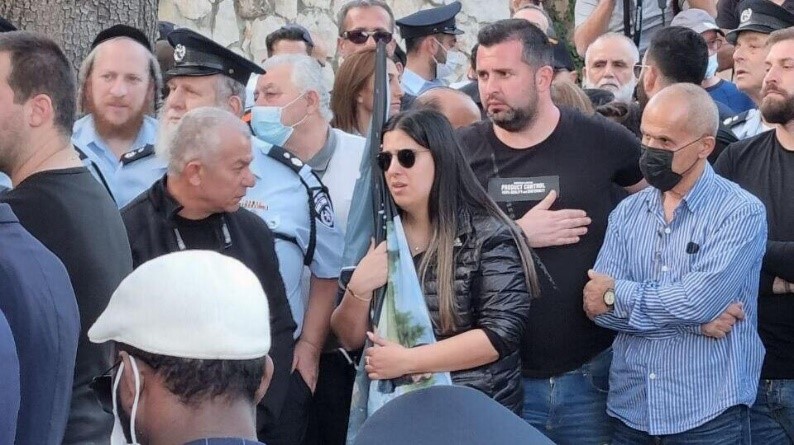
The funeral ceremony was held at the Church of Annunciation in Nazareth. Shani, his Jewish fiancé, hugged the Police Force flag and saluted: “My hero, you are now the hero of all of Israel!”

Images from Amir Khuri’s funeral (credit: Ynet.co.il)

Several terror attacks had hit us in the past couple of weeks, yet the media dedicated much airtime to this story. Probably because of its uniqueness. An Arab terrorist (a Muslim), that was planning to die while killing Jews, ends up killing another Arab; and the victim, on his end, was willing to sacrifice his life in order to save Jews.

Two orthodox Jews were also killed in that attack, both residents of Bnei Brak. The willingness of a Christian Arab to jump into the fire in order to save Jewish lives has stirred up a mini-revolution in that city. Its residents are not used to such gestures coming from Arabs. The funeral, though held in a Christian location (which is considered defiled by the Orthodox) was attended by many Rabbis and orthodox Jews.

A “Ruler who Whitens” and a “Red One who is Straight”

So much symbolism is embedded in this story, even in the very names of Amir and Shani.

Amir Khuri means in Hebrew “a prince, a ruler, a governor, a nobleman who has turned white”. Shani Yashar (his fiancé’s name) means “red and straight”.

For the first time ever the municipal authorities of Bnei Brak have decided to commemorate a non-Jew. Almost unanimously everyone voted to name one of the city’s streets, that up to that point were always named after Jewish heroes, in Khuri’s name. That’s their way of honoring his bravery and the fact that his actions prevented a greater tragedy.

I am trying to imagine the day in which a street in Israel will be named in honor of another Hero, one who was willing to jump into the fire to save Jews – of Yeshua the Messiah. I can’t think of an emoji that will depict our astonishment when that will happen.

We do know that such a day will indeed come, as the whole land will be called by the name of its rightful owner, in whose wings all the above symbols and many more are expressed: healing, law-giving, righteous judgment, and the power to turn our sins white as snow as He puts us on a straight path.

One At a Time

Welcome, Yeshua! You are the only Ruler and Prince (Amir), in whose Red (Shani) Blood our hearts are made White (Khuri) and Straight (Yashar). Even though entire streets or cities are not called in Your name as of yet, we rejoice over each Israeli heart that realizes The Hero of Israel was willing to give His life for him or her.

I thank you that our nation is able to recognize a hero when we see someone who is willing to give his life, not only for his own loved ones, but for those who are considered to be enemies.

As Passover approaches, I ask that You open more eyes among our people, specifically this time among the Orthodox in Bnei Berak. Enable them to see the Jewish Face of the one who is still considered the greatest enemy of our nation.

Please stretch Your mighty Arm so we can fathom the fact You had sent Your Son to His suffering. Amir’s father cried bitterly and said that all he wants right now is to have his son back home, with him. If asked, I doubt he would willingly send Amir to this final watch of his. So understandable. But there is nothing he could have done to prevent the outcoming.

El Gibor (Mighty God), Pe’le (Miracle), use this story to soften another layer in our hardened hearts. Amaze us with the sobering realization that although You could have prevented Yeshua’s death, we are carved so deep on the pupils of Your eyes, that You chose to let Him go.

I also ask that Amir’s family and his fiancé will acknowledge the full price that has already been paid. As the Christian world is preparing to celebrate Your death and resurrection, please work in their hearts and turn their mourning into joy.

“NaHafoch Hoo”

Design credit: Maya Kaplan, mymodernmet.com

In one of the climaxes of the story the narrator declares this phrase which means: the opposite, things have turned around (it is translated in Esther 9:2 into “the tables have turned”).

Just when the antisemites around the Persian empire thought they are about to annihilate the neighboring Jews, the tables have indeed turned and they themselves became the prey.

This turned into one of the reasons behind the colorful costumes that characterize the feast of Purim, even though the Bible does not say a word about it. The costumes declare: “what you think (and what you see) is not what you get. Behind the scenes there is another layer, well hidden.”

Hiddenness

There is much hiding of truth throughout the book of Esther. It starts with the very name of the book, which means “hidden”, and continues with the fact that God is not mentioned even once, though it is clear that He is the one who causes all the “coincidences” to occur at just the right time.

In addition to that, Esther does not reveal her true identity until later in the book. She hides her Jewish origin and name even from the king.

Opposites

There are also many opposites and reversals of circumstances all over the book:

The original plan was to humiliate Mordechai by Hamman, but “NaHafoch Hoo” takes place, and Mordechai ends up with honor and becomes second in command to the king (10:3);

Instead of hanging him, Hamman is the one who ends up hanging from the gallows;

The 14th day of the month of Adar was destined originally as a day of sorrow and destruction, yet turns into a day of rejoicing; The day of mourning became into a day of celebration (9:22).

A Little Bit of History

Mordechai came with the exiles from Jerusalem to Persia (more accurately to Babylon, which was later conquered by Persia), so at the very least he is 60 years old when the book begins. Esther is obviously young, so she was born in exile.

The cruel Babylonian kings dispersed the Jews throughout the empire; The Persian rulers came up with a different policy. They figured that a calm and peaceful nation will not rebel against a conquering empire, and thus allowed the exiles to return to their homelands and worship their own gods.

The plot of Esther’s scroll takes place over the span of about 4 years (starting at 483 BC), a few decades after Cyrus decreed that the Jews are allowed to go back to their homeland and build the temple (538 BC). Cyrus’ decree played a role in fulfilling God’s promise to bring His people back, as it started waves of immigrants returning to Zion after 70 years in exile. Some of these waves are recorded for us in the Bible, mainly those led by Ezra and Nehemiah.

Only about 42,000 Jews chose to make it back home to Zion. Probably because life in Judea required a heart and mind of a pioneer.

The Comfort of Exile

life in Persia, on the other hand, was comfortable. Most Jews who were born in exile did not miss Zion, and have somewhat assimilated into the Persian culture. Evidence of that we find in the pagan names Daniel and his friends take on, as well as Nehemiah, Mordechai and Esther; Some Persian words infiltrated Hebrew and are echoed even in the Old Testament later writings, and that tells us just how common this foreign vocabulary was back then, alongside some foreign traditions the Jews have embraced.

Mordechai and Esther were among those who chose to stay behind. I find a hidden warning right here for the Jewish reader: when you indulge in the comforts that an enlightened exile provides, you put yourself in danger of possible annihilation, with no authority to fight it back.

Did the threat of mass annihilation, though not fulfilled, yet nonetheless hovering over the Jews for long months, bring about another wave of immigration? The Old Testament does not go into these details, but I’d like to believe it did, as a brief look into the matter leads me to an interesting theory.

When war breaks out anywhere, we mostly focus on its geopolitical aspect. We (and the media) discuss in length the offenders and the victims. In the past few weeks, Putin is of course the offender, Zelensky the victim.

And God?

Completely hidden!

But even when God’s image and His outstretched arm are hidden from the all-seeing lenses of camera-men and journalists, there is no doubt He is in full control, pulling the strings. What at times may look like a series of happen-stances, actually advances His plan.

Wars have two important ramifications, that the media doesn’t even know it’s supposed to cover. The breaching of known borders brings the Gospel to new places. Believers, among others, turn into refugees and are forced to leave their comfort zones; Refugees leave countries in which the Gospel was outlawed and end up in places in which talking about Yeshua is allowed; the terror war strikes in the hearts stirs the fear of God in many people, and so on.

And there is another important ramification, a prophecy that is being fulfilled behind the scenes when war breaks: the eyes of Jews living in danger zones are opened, they start seeking solutions they never thought they will need again, and they realize they have a place much safer than foreign paradises. That’s when new waves of Aliyah to Israel begin to form.

Since the war between Russia and Ukraine broke, thousands of Jews have already made Aliyah (immigrated) to Israel. These numbers are expected to rise weekly. They are coming from Ukraine, and from other bordering countries: Moldova, Latvia, Croatia, even Russia. And Israel is sending airplanes and teams to the borders, in order to rescue Jews who are running away from the war zone.

Tables Turning Over

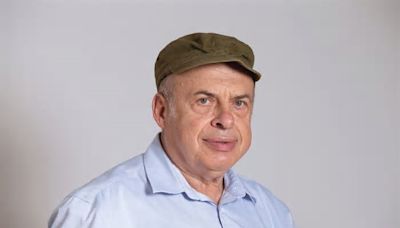
Nathan Sharansky, born in Ukraine, was held captive in Russian prison for 9 years as a prisoner of Zion, until his immigration to Israel in 1986. He later became a member of the Knesset, and today is a proud Israeli. A couple of weeks ago he attended a wedding of a terror attack victim. During the wedding Sharansky shared a little about his childhood in the former USSR:

“There were various nations in Ukraine. A birth certificate stated the person was ‘Russian’, ‘Ukrainian’, ‘Georgian’, ‘Cossack’, etc. But none of these really mattered, there wasn’t a big difference between them. One thing did make a difference – if your certificate stated you are a ‘Jew’. In that case, you were considered as if you had some disease.

“Being Jewish brought antisemitism and hatred. No one needed to replace the word ‘Russian’ with the word ‘Ukrainian’ in their IDs in order to get accepted to university, for example. But if a Jew could somehow change what is written on his ID, his chances improved.

“I was reminded of it when I saw thousands of people standing at the borders of Ukraine, attempting to escape the present tragedy. They stay there night and day, unable to escape. However, there was only one word that could help some get out: ‘Jew’. Those who are Jewish knew there are other Jews at the border, who came to take care of them, and that their chances of escaping are much bigger.

“When I was a kid, ‘Jew’ was a bad word. No one envied us. Today, at the Ukrainian border, ‘Jew’ turned into a good word. It describes those who have a place to go to, those who have an entire nation awaiting them on the other side.”

Think about it: since the establishment of Israel, the term “Jewish refugees” is non-existent. Jews who flee a war zone don’t need to look for a country that will pity and take them in. They simply always have a home.

Oh, how the tables have turned!

Faces In the Snow

Once a year or so we have a snow in Jerusalem. That was yesterday. Though it can get pretty cold here, snow is not something we are accustomed to. As soon as the first flakes started pouring, kids were out in the streets, enjoying this once in a blue moon experience to the fullest.

This picture was taken on my front porch.
I love how the snow looks like flames of fire in God’s menorah!

Many pictures and clips of Jerusalem covered in snow have flooded the web in the past 24 hours, somewhat shadowing something profound taking place today in this unique city.

The walls of the old city were flashed with images of holocaust survivors from various places in the world, in commemoration of the International Holocaust Remembrance Day. Luigi Toscano is a German-Italian photographer, and he is behind this moving initiative. The idea is to flood social media with the memory of the holocaust, so that the younger generation will know what happened, lest they forget. This is done in an attempt to combat some of the growing waves of antisemitism these days.

Another initiative called “Live Forever” is using holograms containing holocaust survivors, as they are sharing their poignant, heart wrenching stories, which are so important to hear and remember.

Images of holocaust survivors flashing over the walls of the Old City
(Picture credit: Shachar Azran, WJC)

This week we will be purchasing some extra warm blankets, heaters, and other supplies that will help our dear friends stay warm during the cold winter. I hope we can distribute it all by the end of next week. If you are interested in joining us in this act of kindness, we invite you to send a donation designated for this purpose. Donations can be made by check or via Paypal. Contact us at otoomofet@gmail.com for specific details so we can ensure the donation is designated and applied correctly.

Happy Hanukkah

As darkness seems to deepen and cover more and more parts of this earth, what a delight it is to be able to lift our eyes up; Far above that darkness, unto the Light of the world, whose light always has and will shine brighter.

We are hard at work in preparation for a Tabernacle seminar, offered for the first time in an intensive 9 day format to Hebrew speakers only. So far we have only offered it in this format to tourists. So starting next week, we will teach the whole program in one shot, and coach 12 participants as they go through the deep process of building a glorious tabernacle in their hearts, out of the acacia thorns abundant in their lives.

One of our participants comes from an ultra-orthodox (Haredi-Jewish) background, two are from a Muslim background. Most have just recently finished their army service, and some gave their hearts and lives to Yeshua not very long ago.

We will teach them all to enter through the Gate and at some point face the light of the Menorah (Lampstand), as they draw closer to the Throne of grace – the Holy of Holies.

We invite you to join us in prayer as we carry each of these precious 12 through this complex and exciting process.

Yesterday I was walking through the streets of my quaint neighborhood, when I came across this huge Menorah, set up on the roof of one of the local synagogues. It is made of copper pipes and bolts. I doubt they meant for that to happen – but the arrangement of the pipes actually creates the name of Yeshua in Hebrew.

It immediately birthed a cry in my heart, for their eyes to open and their hearts to speak the Name above all names – the one who IS the true Light. Lord, make it a reality in their hearts. Form Your name on their lips, even without them realizing it. Reveal your Son’s true name to them.

Will you join me in that prayer?

With that in mind, I want to wish you all a happy Hanukka! As we celebrate this Feast of Lights and lift our eyes to the Light of the World, let us all allow Him alone to guide our paths, so that in all things His name be lifted up on every roof top.

The Joy of Toireh

Sounds of singing and ululations woke me up this morning, the eighth day of Sukkot.

“Hakafot”, I thought. Today is “Simchat Torah” – the day during which the Torah is celebrated and rejoiced in. In synagogues worldwide, Jews will finish reading the last Parashah (portion) in the book of Deuteronomy and start reading all over again from Genesis.

Until the Babylonian captivity in 597BC, the public reading cycle of the Torah lasted three and a half years. Only in exile was the practice changed to reading the entire Torah in one year. Gradually, this has become accepted by the entire nation.

Toireh – this is how Ashkenazy Jews pronounce “Torah”. The name of the feast, “Simchat Torah”, is not Biblical. It was introduced in the 8th century AD and was designed to describe the joy that fills the people once the reading cycle of the Torah culminates.

In most synagogues, all Torah scrolls are taken out of the Ark, and the crowd dances with them, circling the Bima (stage) seven times, while singing and rejoicing. When the seventh Hakafah (round) starts, some synagogues bring the Torah scrolls out to the people gathered outside, and everyone reaches out and kisses the decorated cover. This ritual takes place only once a year and attracts visitors from the entire country.

I dressed quickly and walked around my quaint neighborhood. It is located in the center of Jerusalem and was established about 140 years ago (1875). In some ways it resembles the old city, with houses built like small walls around inner courts, sprinkled with dozens of tiny synagogues in many corners. The sounds of rejoicing and celebration arose from every direction. Benches were put out in the streets to enable women and children to watch the first six Hakafot, which were taking place inside the men’s courts within the synagogues. Everyone just waited for the scrolls to be brought out on the 7th round.

The joy and laughter when that started. Forget Corona restrictions! The crowds started moving towards the scrolls, desiring to touch them for a second. “Yibaneh HaMikdash” (Let the Temple be built) and “Hoshiah Et Amecha” (Save Your people, based on Ps. 28) are some of the main songs the crowd repeatedly sang.

Hoshia Et Amecha, Hakafot 2019 in Har HaMor Yeshivah

I listened and prayed: “Answer their prayerful songs, God. Gather these stones, turn each one of them into a living stone and build a temple they can’t even fathom. The yearning and zeal for Your Word they display… the bitter tears they will shed once they realize that this Torah, that so reverently they bring out of its holding place once a year, kissing and rejoicing in, have put on flesh, and came to dwell among us long ago. Use this emotional vibe that is filling the streets right now and breathe life into it. Show them what price your Word has paid so that each one of them can turn into a stone in your Temple. Save, oh Lord, your people, and bless your heritage. Shepherd and carry them up forever (Ps. 28:9).

Even Israel’s hospitals celebrate the Hakafot. Here’s the version of the staff at one of Israel’s ICUs from last year.

Photo credit: https://www.ynet.co.il/judaism/article/Syvd7d1Pw

There

“I will come down and speak with you there…” (Num. 11:17)

The Great Escape (photo credit Brian Oldham, on flickr)

Moses was getting ready for an event every leader longs for: recruiting helpers that will carry with him the burden God has placed on his shoulders. God commanded him to appoint 70 elders for that purpose. Not a small number, but not that many either, considering the magnitude of the flock they had to oversee.

In verse 16 God tells him to gather those whom he – Moses – knows to be Israel’s leaders and officials, and bring them to the Tabernacle. How could Moses know who these leaders and officers are? Didn’t he have` his plate full as it was from dusk till dawn? And why does he have to bring them to the Tabernacle, to the Tent of Meeting, of all places?

Because that is exactly where they were about to be tested. The Tabernacle is where we are all tested, where our real stand with God is expressed. I assume Moses could recognize the candidates for the job only because they have been faithful and diligent to come to him, while he was sitting at the gate of the Tent and judging the people. From there he could see who brought their sacrifices as required; how they treated others; how they approached the priests and in what regards; how they ministered even before they were appointed.

Where Is There?

Earlier God made it clear to Moses where He will speak to him. The “there” verse 17 refers to is described in Exodus 25.

“There I will meet with you, and I will speak with you from above the Mercy Seat, from between the two cherubim which are on the Ark of the Testimony, about everything which I will give you in commandment to the children of Israel” (Ex. 25:22; also see Ex. 29:43, Num. 7:89 and elsewhere).

Our half scaled model of the Tabernacle

Such a specific location. This is not just some unidentified spot within the Holy of Holies, or across the Mercy Seat. It was specifically within the triangular space created between the two cherubs placed upon the Mercy Seat.

How Does One Get There?

How could Moses get there? For only the high priest was allowed to enter that specific spot, and that, only once a year – on the Day of Atonement (Yom Kippur, which starts today).

Back then, these were indeed the restrictions. But Moses, being Moses, symbolizes a path that Yeshua, the Prophet-like-Moses, was about to open wide for all of us. Today the path that leads “there” is wide open and the entrance fee is fully paid for anyone who trusts in the Blood (Heb. 12:9-11). Only these people can get “there”, and clearly hear what God says to them about us, Himself, and others.

One Important Point

We can’t just hop our way over there, skipping what is in our path. Yes, the Gate is open and the path is sprinkled with Blood that has prepared the way for us, but we still must enter in through the only Gate, that narrow one, and then do that which the priests did by each of the Tabernacle’s furnishings.

Otherwise, we won’t truly know if it is God speaking to us when we hear something, or maybe our flesh or, God forbid, some other voices.

The Process

What did the priest do by each piece in the Tabernacle in order to get “there”? And how are we to do that today?

This is a lifelong process for any disciple, who desires to always hear Him “there”. You constantly have to wash your heart and understanding with the blood of repentance and forgiveness (Bronze Altar), with the living water of the Word (Basin), allow the Holy Spirit to lead you to all truth (Lampstand), digest fresh Manna (Table), burn incense that is deeply connected to the process you have just been through (Golden Altar), etc.

Ot OoMofet’s Tabernacle workshops focus on this process (a discipleship program that lasts several months or can be taught in an intensive format over the span of 10 days).

For the theoretical part, you are welcome to watch https://www.youtube.com/watch?v=8zcAIbA7a1s (part 1) and https://www.youtube.com/watch?v=WLYXMqUgh8I (part 2).

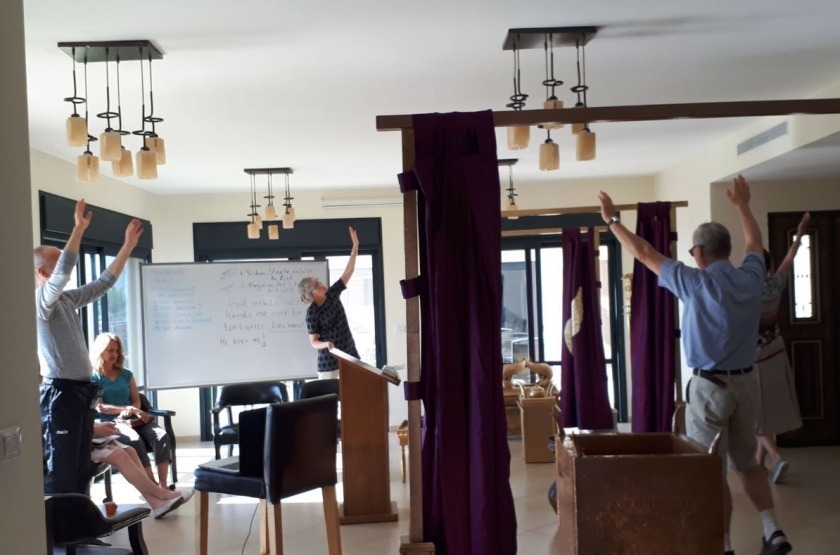
Taken at one of our intense ten-day workshops.

Up and Down

How many times did Moses climb up the mountain to get “there”? For years I thought he did so twice. Once to receive the tablets upon which God inscribed His commandments, the second time to write them himself. But one day I marked each reference and realized there were many more times.

Eight instances in which Moses went up the mountain are mentioned in that Torah portion. “God, have mercy”, I thought. “The guy’s already upwards of 80 years old!” But then I got it: turns out we are always called to climb higher, and then a little more, in our intimacy with God. It may seem tedious to us, even redundant, until we get to that place where He is “there”. A place in which no questions are left unanswered, ascending and descending is as natural and easy as it is for a gazelle, our needs are so fully taken care of, that even eating and drinking are not an issue, and there’s nothing left for us to do – besides being!